A compilation of random and interesting things, musings, musics, videos, and more. Brought to you by a UChicago student with a penchant for procrastination.

Wednesday, May 14, 2008

Madeline Albright Lecture

Tonight I had the great opportunity to listen to a talk deliverer by Madeline Albright at the University of Chicago. The full title of the event was the Thomas Garrigue Masaryk Lecture on Democracy and it was premised on a deep connection between the University and the Czech Republic, stretching back to an original series of talks given by Masaryk, the founder and first president of an independent Czech Republic, in the early 20th century.

The introduction to the talk was presented by Dean Boyer as well as the  Ambassador of the Czech Republic to the United States, Petr Kolár. It served to establish Albright's Czech origins and her work in American politics. Though these introductions were longer than Albright's whole talk, there were some light moments. Such as when Kolar jokingly said he and many in the Czech community had tried but failed to persuade Albright to run for President in the Czech Republic, though he didn't hold the fact that she refused against her.

DSC00827

The lecture was held at Rockefeller Chapel, and filled the entire venue.

Albright finally took the podium and presented the lecture with an inspiring air of confidence and composure. One of the main points she pushed across with her talk was the notion of responsible leadership at the heart of a true democracy. She specifically called out China and Russia alongside Iran, as failing their duties to their citizens with regard to adhering to certain standards for human rights. Yet, while the US used to have a moral vantage point from which to make such criticisms, she conceded that the US is itself now no longer in a very positive position. There was especially a lot of applause after her condemnation of Guantanamo.

 DSC00825

After her talk, Albright fielded an impressive array of question form the audience. She touched upon everything from the role of the AU to the question of US involvement in Pakistan to her reasons for endorsing Hillary. The most interesting question however, came at the very end, when someone asked her about the legitimacy of the Hamas as a democratically elected party in Palestine. Albright agreed that this was a very difficult question, and began to qualify the definition of democracy.

Her inability to accept the legitimacy of Hamas lay in the fact that the group uses violence to achieve it's aims. Though it has a strong stake in the well-being of the people and the community, the use of violence to achieve its aims ultimately discredited them on an international level.

So again, the this moral element is directly linked to the definition a truly democratic state. While Hamas can be seen as representing exactly what the people of Palestine want - efficacy in pursuing national aims, despite the violence, their immoral means discredit their democratic election to power. Albright's only means of resolving this was ultimately to claim that the opposition party, Fatah, could have offered just as much to the people, without the violence, but failed to do so, thereby failing the democratic process. If indeed there had been adequate choice, then Fatah, the right party, would have been chosen.

Ultimately, questions like this reflect the fact that it really is quite difficult to present an universal description of democracy. I applaud Albright's attempt to do so, yet the notion that democracy should be the ideal system to emerge under any circumstance is difficult to accept given the wide array of regional and historical contexts for all states and their citizens. While the link between economic prosperity and democracy is well established, the push for democratic processes under adverse conditions and in a context that would not support it, can only cause more harm.

2491283962_62aca70f7a_b

Better photographs on flickr c/o victorchen55

Either way though, I'm going to lighten this post up and say that Albright definitely had the best comment of the night. When referring to the White House she quickly quipped that she hadn't seen any intelligence out of there in a long time. In more ways than one.

Labels: ,

Friday, August 25, 2006

Edu-tastic Video Compilation

Even now, after having graduated from high school, I have to admit - it really is difficult for me to separate myself from the educational fun-ride that was k-12. Everywhere I look, it seems, I find benchmarks of my educational upbringing, from French dictionaries gathering dust on my bookshelf to one random elementary school spelling book that I should've definitely returned about nine years ago. It's been fun to rummage through old grade reports, laughing at awkward class photos, and sympathizing with elementary school teachers who racked their brains to try and impart some form of factual information to us.


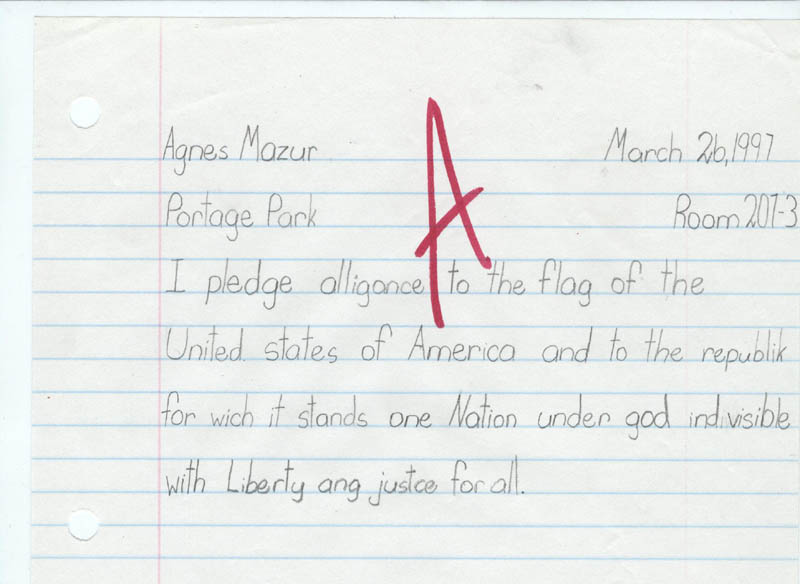
Seriously though, an 'A' for all those spelling mistakes and random capitalizations? I would've deported myself outright for pledging 'alligance' to a 'republik' run by a lesser 'god' than He who directs the thoughts and actions of his progeny George W. Bush


Yet the internet has been the ultimate harbinger of memories connected to those nostalgic years - with the ability to simply Google old PBS educational shows I've been able to find countless reminders of the clever ways in which adults choose to inundate children with massive amounts of facts. And while giant purple dinosaurs perhaps are better suited for giving children an irrational phobia, one reoccurring technique has definitely stuck out for it's practicality - songs.

Since the dawn of time, it seems, as long as there have been core factual concepts (mathematics, science, history, language) people have always attempted to commit their base principles to memory through simple and repetitive forms. Things like mnemonic devices (SOH CAH TOA, Roy G. Biv, My Very Educated Mother Just Served Us Nine Pizzas*), rhymes, sayings, and songs have attempted to make the chore of pure repetition more mentally expedient. Sure, simply memorizing things through rote repetition is a staple hallmark of childhood (from reciting prayers or the pledge) -- yet songs have always added that extra bit of excitement that could trick entice a hyperactive child into doing some inadvertent learning.

But returning to the point, I don't think any s
ort of nostalgic post about the magic of song in education could be complete without a rundown of the very songs which permeate my subconscious mind, making me a slave to catchy jingles and quickly recited bits of information. Below is a compilation of the videos which I consider to have the most creative and powerful use of song to achieve that perfect jingle to fact ratio.


Ah, the Animaniacs - with their take on the nations of the world who could go wrong? Although, they did misspell Israel as 'Isreal' -- but I'll give Yakko a break, for a singing whatever-the-hell-it-is that's still pretty good.


School House Rock made my One Saturday Mornings notable (next to Doug, Recess, and Pepper Ann) -- and as far as this integration of the bill-making process to song I'd say it definitely has raised my political efficacy ... what person doesn't still secretly wish that the next bill passed could befriend them and after breaking out into song do a Kool-Aid man sort of "oh-yeah!" cheer?


Sesame Street always had tons of innovative clips presenting letters, colors, and numbers - so what better way to convey the concept of '6' than with a psychedelic pinball machine countdown?


Ok, this isn't necessarily an aide for conventional knowledge - but it sure did work for brainwashing me into being aware of the dangers that evil villains pose to the environment. But man, captain planet was a tad creepy himself, at least the cute South American boy with the pet monkey made up for it. We're the planeteers, you can be one too - cause saving our planet is the thing to do!


While I couldn't find an embed-able version of this next one, the Periodic Table of the Elements song by Tom Lehrer has been a standard for Chemistry teachers across the nation since 1955. If you've never encountered this song in class then you've missed a chemistry hot-topic that's almost as fascinating as the idea of the mole (Avogadro's number, equal to 6.022 x 10²³ atoms or molecules). You can however find a flash version of an animation done to the song at privatehand.com/flash/elements.html


And a treat, perfect for Pi Day! An amazing parody of all of the above, with the perfect dose of humor tossed in -- no Steve, not Pie, Pi (and in case you were hungry for that pi goodness, or just insane, you can find pi calculated to a million digits at piday.org)

* Note: seeing as Pluto has been demoted to the status of a dwarf plant (or trans-Neptunian object) alongside Ceres and 2003 UB313 as of August 24, 2006 ... I guess elementary school kids can go with something like My Very Educated Mother Just Said Uh-oh No Pluto (here's a visual).

Technorati Tags: , , , , , , , , , , , , , ,

Labels: , , , , ,

Tuesday, August 15, 2006

TED Conference Videos

If there's one thing that Google Video can claim in it's ongoing struggle against YouTube's size and interface - it's the amount of professional resources, documentaries, and otherwise inaccessible video footage (see C-SPAN's White House Correspondent's Dinner) that it provides for the everyday, Google-browsing, John Q Public.

This effort, while seemingly dwarfed by the amount of content available on YouTube, has a striking advantage in the quality of video made available. And that is probably why, on my last traipsing through the Google Video hallowed grounds, I happened upon a treasure trove of sorts - a collection of presentations that were not only informative, but actually interesting ... a shocking discovery to say the least.


The TED (Technology, Entertainment, Design) Conference videos, sponsored by BMW and Google Video, host an amazing roster of individuals who are not only passionate about their fields of study - but can express themselves in a way that leaves you inspired by the potential for the future. These "trusted voices and convention-breaking mavericks, icons and geniuses" really are a pretty neat bunch, and Google Video presents their various talks on one easy to access page with the suggestion "plan to listen to at least three, start to finish. They have a cumulative effect..."

After watching the presentation of one man specifically, Hans Rosling,
a public health expert and director of Sweden's world-renowned Karolinska Institute, I was truly enlightened. Rosling's presentation revolves around opening individuals to the current state of the world and debunking the myths floating around concerning the relative status of life in different countries. Fundamentally, the point that really resonates throughout the presentation is the fact that such stereotypical mindsets continue to prevail in the face of data that is screaming the opposite. Watching the presentation I was forced to confront beliefs about world health that are not only outdated but generalized. If you get the chance, watch it below and see if it affects you as much as it has me.


Ultimately, the goal of Rosling's presentation simply underlines the greater goal of his non-profit organization, Gapminder.
With an initiative to 'gap' the bridge between global statistics and an accessible view of the health situation in the modern world - the impact of this work could lead to not only a more educated public, but viable changes in public policy and the means through which global problems are assessed and solved. Having e-mailed Mr. Rosling after watching the performance, he responded by noting "do use, download and spread what we have on www.gapminder.org" -- Will do.

Update -- You'd better believe that I've snagged these conference videos for my Video iPod. iTunes offers free video podcasts subscriptions to the presentations, which you can access at itunes.com/podcast?id=160892972
(note, this will request to run iTunes)

Technorati Tags: , , , , , , ,

Labels: , ,